How to Start a Pressure Washing Business: Costs, Rules and First Jobs

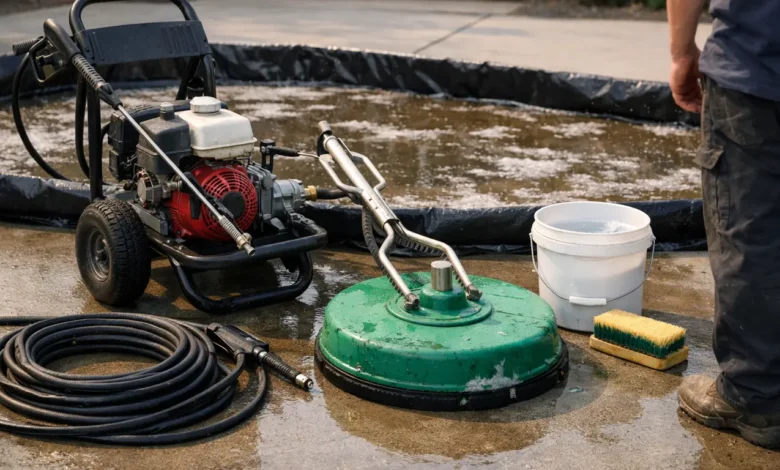
A starter setup for a pressure washing business costs about $3,464, and a trailer rig with a helper reaches $10,556.86. Most of that gap is the trailer and workers’ comp for one helper ($4,461 of the $7,093 difference), not the machine.
This guide is for someone in the US who owns a pressure washer, or is about to buy one, and wants to start a pressure washing business this month: dated equipment prices, the license and wash-water rules, a quote you can copy, and a 30-day plan.
If you have not settled the structure, the name or the bank account yet, start with the WealthRadaar guide to starting a small service business and come back here for the machine, the pricing and the customers.
Quick answer
- Budget about $3,464 for a lean start: a 4 GPM, 4,000 PSI machine at $1,690.00, a 20-inch surface cleaner at $525.00, consumables, a California LLC filing at $70.00, and a year of general liability cover at an $879 average.
- Call your city stormwater office and ask where wash water may go before you take a job. In Portland, Oregon, wash water is banned from the storm sewer, and discharge to the sanitary sewer needs city approval.
- Check your state contractor board’s dollar threshold. California’s rose to $1,000 on January 1, 2025; hiring a helper or needing a permit changes what it covers.
- Price from measured square footage, not by eye. At $0.20 per sq ft, a 2,000 sq ft house wash bills $400.
Is a pressure washing business right for you?
Much of the work is preparation: moving furniture, pre-wetting plants, masking outlets, dragging hose, and rinsing chemical off siding before it dries. Homeowners buy one-off cleanups; property managers buy recurring walkway and dumpster-pad work.
As a planning assumption, not a sourced figure, this guide treats the busy season in a cold-winter state as March to October. Southern markets may work all year. If you are weighing this against mowing, our lawn care business guide covers the closest alternative.
Good fit if:
- You can load and unload the machine on your own and work on a ladder for an hour.
- You are comfortable handling sodium hypochlorite and reading a safety data sheet.
- You can knock on a door and quote a price on the spot.
- You have a legal place to send the wash water.
Not a fit if:
- You plan to use whatever machine you already own for every surface.
- You want a business that runs without you quoting jobs for the first year.
- Your city will not let you contain or discharge the wash water, and you do not want to haul it.
How much does it cost to start a pressure washing business?
The equipment rows use dealer prices captured on 21 November 2026, not averages. The three columns are three setups: a lean solo start, a mid-range solo rig, and a trailer setup with one employee.
| Item | Low | Typical | High | Source |
|---|---|---|---|---|
| Pressure washer, 4 GPM | $1,690.00 (BE, 4,000 PSI) | $1,994.15 (Pressure Pro, belt drive) | $2,950.00 (Mi-T-M CA-4004, listed out of stock) | Dealer listings, November 2026 |
| Surface cleaner | $525.00 (20 in.) | $824.00 (24 in. stainless) | $1,096.86 (Whisper Wash Classic) | Dealer listings, November 2026 |
| Hose, nozzles, injector, chemicals, PPE | $300 (estimate) | $400 (estimate) | $500 (estimate) | Estimate, see below |
| Utility trailer, 5×10 new | — | — | $2,700 | Jim’s Trailer World listing, November 2026 |
| General liability insurance, year one | $879 | $879 | $879 | Insureon average, $73/month |
| Workers’ comp, year one, one employee | — | — | $1,761 | Insureon average, $147/month |
| LLC filing, California example | $70.00 | $70.00 | $70.00 | California Secretary of State, Form LLC-1 |
| Website, phone, invoicing software | $0 | $600 (estimate) | $600 (estimate) | Estimate |
| Total | $3,464.00 | $4,767.15 | $10,556.86 | Sum of the rows above |
The machine and cleaner prices come from dealer listings at PressureTek, SLE Equipment and American Cleaning Equipment. Each was the listed price on the day it was checked, not an average. The Mi-T-M was listed as out of stock.
A work vehicle is not in the table, because it depends on what you already own. The federal Employer Identification Number is free.
The estimate rows are retail-based, with no dated supplier invoice. About $300 to $500 covers the hose, nozzles, injector, chemicals and safety gear.
What the budgets buy:
- $3,464.00 buys a direct-drive 4 GPM machine, a 20-inch surface cleaner, consumables, a year of liability cover and the California LLC filing fee. It assumes you already own a work vehicle.
- $4,767.15 adds a belt-driven unit with a General pump, a 24-inch stainless cleaner, and money for a website and invoicing.
- $10,556.86 adds a 5×10 trailer, a Whisper Wash Classic cleaner, the Mi-T-M machine at its listed price, and workers’ comp for one employee.
For a lower-equipment trade, see our breakdown of what it costs to start a cleaning business.
Licenses, permits and insurance you need
There is rarely a license category called “pressure washer.” What decides your paperwork is the dollar value and type of work, plus where the water goes. Check each point below with your own state and city, because the thresholds differ.
Contractor licensing: the dollar threshold that decides it
California is the clearest published example. A new law raised the threshold for work requiring a contractor’s license from $500 to $1,000, effective January 1, 2025. An unlicensed person may complete projects up to $1,000 only if they do not hire workers and no building permits are needed. An unlicensed person who advertises construction work under $1,000 must state that they are not licensed.
Read that as one state’s example, not a national rule. In practice, hiring a helper or needing a permit can change whether a job falls under contractor licensing in your state. Check your state contractor board’s threshold before you print a flyer.
Wash water: where the water can go
Wash water is the part of this trade with the most legal exposure. The EPA explains that certain operators of municipal separate storm sewer systems (MS4s) must obtain NPDES permits and develop stormwater management programs to keep harmful pollutants out of those systems.
Portland, Oregon shows what a local rule looks like. City Code 17.39 prohibits discharging wash water from pressure washing into the stormwater system, and City Code 17.34 requires approval to discharge to the sanitary sewer. The city’s guidance points pressure washing businesses to a Mobile Washer Discharge Authorization. The city says a discharge can lead to investigations, penalties and required corrective actions.
Three paths are common. Which one is lawful depends on your city:
- Contain and haul. Use a berm, a vacuum recovery unit or a containment mat, pump the water into a tank, and take it to a facility that accepts it. This is the costliest path, but it does not depend on a drain.
- Discharge to the sanitary sewer with approval. Wash water goes to a drain that leads to the treatment plant, not a storm inlet. In Portland this needs city approval through a Mobile Washer Discharge Authorization.
- Divert to soil on the property. Portland’s guidance allows only non-toxic, non-hazardous wash water onto a vegetated or unpaved area on the same property, and never into a rain garden or stormwater planter.
Two questions decide the path: where the drain at this address leads, and whether your chemicals meet the non-toxic, non-hazardous test before any soil diversion. Ask the city’s stormwater office before the first job, not after a complaint.
Insurance you actually need
| Cover | What it pays for | What to expect |
|---|---|---|
| General liability | Financial loss from bodily injury, property damage and lawsuits, per the SBA | $73/month average, about $879 a year |
| Business owner’s policy | Insureon’s listing for this trade; ask what it includes | $142/month average |
| Workers’ comp | Coverage for employees hurt on the job | $147/month average; required in California even with one employee |
| Commercial auto | The vehicle while it works for the business | Quote separately; not in the table above |
Insureon reports these as averages drawn from the median cost of policies among businesses that apply for quotes through it. Treat them as planning numbers, not quotes. Ask whether damage to a surface you were hired to clean is excluded.
Once you hire, OSHA’s Hazard Communication standard applies. Employers must keep safety data sheets for each hazardous chemical at the workplace, readily accessible during each work shift, and must train employees on the hazardous chemicals in their work area at the time of their initial assignment.
Setting up the business
You can start as a sole proprietor and add structure later, but know what you are choosing. The SBA says a sole proprietorship does not create a separate business entity, so business assets and liabilities are not separate from your personal assets, and you can be held personally liable for the business’s debts. An LLC protects you from personal liability in most instances.
Four steps, in this order:
- Choose the structure, then register it. The SBA says you choose a business structure before you register with the state, and most businesses also need a tax ID number and the appropriate licenses and permits. The WealthRadaar business setup guide walks through the trade-offs.
- Get an EIN. Apply on the IRS website. It is free and issued online in minutes. Beware of sites that charge for one.
- Open a separate bank account and card. Pay for fuel and chemicals from that account only, so bookkeeping is one download at tax time.
- Start a mileage log on day one. Driving between jobs is easy to lose track of, and a log is the simplest way to keep it.
You will pay self-employment tax on net profit: 15.3%, made up of 12.4% for Social Security and 2.9% for Medicare, applied to 92.35% of net earnings from self-employment (IRS Topic 554). For 2026, the first $184,500 of combined wages, tips and net earnings is subject to the Social Security part. That is on top of income tax, so a job that nets $400 does not put $400 in your pocket.
Equipment and tools
Buy for the surface you will wash most, not for the highest pressure number on the box. This guide treats 4 GPM as the working minimum for house and driveway work. That is editorial judgment from equipment specifications, not an industry standard, so check it with an experienced operator.
| Buy now | Price, November 2026 | Add later | Why later |
|---|---|---|---|
| 4 GPM gas unit, 4,000 PSI | $1,690.00 to $1,994.15 | Second machine for a helper | Two operators, two jobs |
| Surface cleaner, 20 to 24 in. | $525.00 to $824.00 | Premium cleaner at $1,096.86 | Only pays on large flat work |
| 150 ft of 3/8 in. hose and nozzle tips | About $150 (estimate) | Extra 100 ft reel | Length is a routing problem, not a cleaning problem |
| Downstream injector and chemicals | About $150 (estimate) | 12 V soft wash system | Needed for roofs, stucco, painted wood |
| Safety goggles, gloves, boots, ear protection | About $80 (estimate) | Fall protection for roof work | Only if you take roof work |
| Ladder, bucket, brushes, pump sprayer | About $200 (estimate) | Water buffer tank | Only when a job has no tap |
Siding, stucco, painted wood and shingles need low pressure and chemical dwell time. A soft wash system is editorial advice for those surfaces, not a published standard. If your market is older housing stock, price a 12 V system before a bigger pump.
How to price your services
Three pricing models cover most quotes. Pick one per job type and stay consistent.
| Model | How it works | Fits | Risk |
|---|---|---|---|
| Per square foot | Measure the surface, multiply by a rate | Driveways, sidewalks, house exteriors, commercial flatwork | Under-measuring; grime level ignored |
| Flat rate per job | One price per service, for example a house wash | Repeat residential work, packages | Leaves money on big jobs, overprices small ones |
| Hourly or contract | Rate per hour or per visit | Property managers, fleet yards, recurring maintenance | You absorb the cost of slow equipment |
Angi’s 2026 data, reported by Angi Pros on completed projects, puts a house wash at a national average of $312, with most homeowners paying $213 to $449. Per-square-foot pricing for house exteriors runs $0.10 to $0.50. Use them as a consumer benchmark, not a rate card.
Here is one illustrative quote. Every input except the listed price is an assumption:
- 2,000 sq ft house wash at $0.20 per sq ft = $400.
- Field time assumed: 3.5 hours including setup, chemical dwell and rinse.
- Chemical and fuel assumed: $18 and $9.
- Contribution: $400 − $27 = $373.
- Contribution per field hour: $373 ÷ 3.5 = $106.57.
The same arithmetic on a driveway: 600 sq ft at $0.30 is $180, one assumed hour and about $6 of chemical, so $174 per field hour.
Set a minimum job price: this guide suggests $150 as a driveway floor, an editorial judgment rather than a market rate. Quote add-ons such as gutter brightening and sealing separately.
How to get your first 10 customers
Fastest first, one action each.
- Your own street. Offer to wash the two worst-looking driveways within 200 yards in exchange for before-and-after photos and a review. Action: pick the two driveways and knock.
- Google Business Profile. A free listing with service area, hours and job photos. Action: create it and add five job photos the same day.
- Door hangers on the street you are already working. Action: print 100 and hang them on the four houses either side of every job.
- Real estate agents. Pre-listing exterior cleaning is a common request before a house goes on the market. Action: call five offices and offer a same-week slot.
- Property managers and apartment complexes. Recurring walkway and dumpster-pad work can even out a seasonal business. Action: read our guide to doing business with apartment complexes and pitch three managers with a per-visit price.
- Local Facebook groups and Nextdoor. Where neighbors already ask for recommendations. Action: answer three “anyone know a pressure washer” posts with a photo and a price range, not a sales pitch.
- Overflow work from established operators. Some operators have more work than they can take on. Action: introduce yourself to three local operators and offer to take overflow at 70% of their price.
The 100 door hangers, the four-house rule, the 200-yard radius and the 70% overflow rate are this guide’s editorial rules of thumb, not measured response rates. Track quotes given and jobs won each month. Ten quotes that become three jobs point to a pricing or trust problem, and the count tells you which.
How much can you earn?
These are illustrative figures, not a forecast. The assumptions are: 46 working weeks; one $400 house wash plus one $180 driveway per pair of jobs; chemicals and fuel at 10% of revenue; an equipment reserve at 5%; and fixed costs of $879 for liability insurance plus $1,200 for software, phone and marketing. A pair of jobs takes 4.5 field hours (3.5 for the house and one for the driveway). Quoting, driving and invoicing add three admin hours a week at two jobs and five at four.
| Line | 2 jobs a week | 4 jobs a week |
|---|---|---|
| Weekly revenue | $580 | $1,160 |
| Annual revenue | $26,680 | $53,360 |
| Chemicals, fuel, water (10%) | $2,668.00 | $5,336.00 |
| Equipment reserve (5%) | $1,334.00 | $2,668.00 |
| Fixed costs | $2,079.00 | $2,079.00 |
| Profit before tax | $20,599.00 | $43,277.00 |
| Self-employment tax at 15.3% of 92.35% of profit | $2,910.55 | $6,114.85 |
| Left after self-employment tax | $17,688.45 | $37,162.15 |
Divide profit by every hour the business takes, not just hours on the wand. Four jobs a week is 14 working hours: $43,277 ÷ (14 × 46) = $67.20 an hour. Two jobs a week is 7.5 hours: $20,599 ÷ (7.5 × 46) = $59.71 an hour. Both figures are before income tax, and they are the numbers to compare with a wage job.
Unpaid travel between jobs and weather delays both cut the hourly figure, which is why 46 weeks is assumed rather than 52.
Your first 30 days
Week 1: machine and technique. Buy or borrow the machine, then wash three surfaces you did not pay for: concrete, vinyl siding at low pressure, and a wooden fence. Pass test: you can clean vinyl without leaving streaks or lifting paint.
Week 2: legal base. File the LLC or confirm sole proprietorship, get the EIN, request three insurance quotes, and call the city about a business license and wash-water disposal. Pass test: you have a written answer on wash water and one insurance quote in hand.
Week 3: first quotes. Set your per-square-foot rates, print 100 door hangers, publish the Google profile with photos, and quote five jobs. Pass test: three quotes given in person, one job booked.
Week 4: first paid work and proof. Complete the booked jobs, photograph before and after, ask for a review at the end of each job, and raise the price by 10% on the next quote. Pass test: three reviews and a price you did not discount.
Common mistakes
Buying pressure instead of flow. A lower-flow consumer unit covers a driveway more slowly than a 4 GPM machine. Fix: compare GPM before PSI.
Blasting siding and paint. High pressure can damage vinyl, stucco and painted wood. Fix: soft wash those surfaces, and test a hidden corner first.
Quoting by eye. A 2,000 sq ft house with a wraparound porch is not the house next door. Fix: measure it and write the number on the quote.
Ignoring wash water until a complaint arrives. Portland’s city guidance says a discharge can lead to investigations, penalties and required corrective actions. Fix: get the city’s written answer and set up containment before the first job.
Working without liability cover. A single damage claim can cost more than the policy. Fix: bind a policy before the first paid job.
Treating revenue as profit. Machines wear out, hoses fail and trucks need tires. Fix: move 5% of every payment into an equipment account.
What to check in your state
Six checks, and the agency that answers each one:
- Contractor license threshold. Your state contractor licensing board. Ask what dollar value and what work types require a license, and whether hiring an employee changes it.
- Business registration. Your secretary of state for an LLC or corporation. The SBA says most businesses also need a tax ID number and the right licenses and permits.
- Local business license and zoning. Your city or county business license office. Ask whether a home-based operation with a trailer parked on site needs a permit.
- Sales tax on services. Your state revenue department. Ask whether exterior cleaning is taxable in your state and for your customer type.
- Workers’ comp requirement. Your state labor or workers’ compensation agency. California requires cover even with one employee.
- Wash-water discharge. Your city stormwater or environmental services office, or your state environmental agency. Ask where the water may go and whether you need an authorization.
Write each answer down with its date and the name of the person who gave it.
Next steps
- Total the low column of the cost table against your savings. If it is tight, price the $1,690.00 machine and the $525.00 20-inch cleaner before you look at trailers.
- Call your city’s stormwater office this week and get a written answer on where wash water may go, then buy containment for that answer.
- Work through the business setup guide to register the entity and get the free EIN before your first invoice.
General information, not legal or tax advice. Confirm licensing with your state contractor board, wash-water rules with your city stormwater office, and tax questions with the IRS or a licensed tax professional.
Frequently asked questions
Often there is no license named for pressure washing. What may apply is a general business registration or city license, plus a contractor license once a job passes your state's dollar threshold. In California that threshold is $1,000, and hiring workers or needing a permit changes it. Ask your city licensing office and your state contractor board which rules cover washing.
This guide uses 4 GPM as the working minimum for house and driveway work. That is editorial judgment, not an industry standard. A lower-flow unit still works, just more slowly. For siding, stucco and painted wood, pair low pressure with chemical dwell time, because a 4,000 PSI tip held close can scar those surfaces.
Plan to skip days when water could freeze on the surface before it rinses. In cold-winter states this guide assumes a March to October busy season, which is a planning estimate and not a sourced figure. Use the quiet months to service the pump, replace nozzles and quote spring work.
This guide's model assumes about 3.5 hours of field time for a 2,000 sq ft house, including setup, dwell and rinse, and about one hour for a driveway. These are planning assumptions for one operator with a 4 GPM machine, not measured times. Extra stories, heavy algae and travel between stops all lengthen the day.
Price most residential work by the job, from measured square footage, and use hourly math internally. At an illustrative $0.20 per sq ft, a 2,000 sq ft house wash is $400. Hourly pricing suits open-ended commercial work where the scope is not fixed.
Sources
- IRS: apply for an Employer Identification Number online
- IRS: self-employment tax
- IRS: Topic no. 554, self-employment tax
- SBA: choose a business structure
- SBA: get business insurance
- California Contractors State License Board: handyperson exemption rises to $1,000
- City of Portland: prevent pollution from pressure washing
- US EPA: stormwater discharges from municipal sources
- OSHA: hazard communication standard, 29 CFR 1910.1200
- California Division of Workers’ Compensation: employer information
- California Secretary of State: Form LLC-1 Articles of Organization
- Insureon: pressure washing insurance costs
- Angi: how much does it cost to pressure wash a house, 2026 data
- PressureTek: gas pressure washers
- PressureTek: 20-inch Whirl-A-Way surface cleaner
- PressureTek: 24-inch stainless Whirl-A-Way surface cleaner
- PressureTek: Whisper Wash Classic surface cleaner
- SLE Equipment: BE 20-inch Whirl-A-Way surface cleaner
- American Cleaning Equipment: Mi-T-M CA-4004 pressure washer
- Jim’s Trailer World: 5×10 utility trailer listing
Figures checked: November 2026